Everyone Has the Same Easy Button

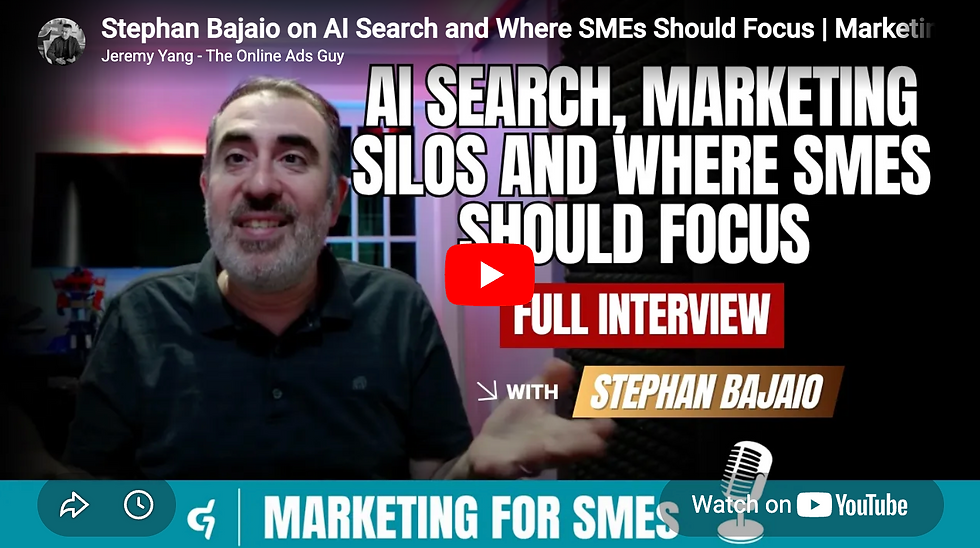
Stephan Bajaio on Marketing in the Age of AI with Emanuel Rose | June 3, 2026
AI gave everyone the same shortcut, and that's where things get tricky. If your content strategy is just about hitting publish, you're doing the same things as your competitors, using the same tool, with the same voice, all at once.
In this episode, Stephan Bajaio talks with Emanuel Rose about why LLM rankings are not really rankings, why the move to AI search is less dramatic than many marketers believe, and why your business's own knowledge is the best way to stand out. If you lead marketing, run a service business, or feel overwhelmed by AI terms, you'll want to listen.
About the Show
This conversation originally aired on Marketing in the Age of AI, hosted by Emanuel Rose.
Connect with Emanuel Rose on LinkedIn.
Watch the Episode
Key Moments
00:00 AI Marketing Shift
00:45 Meet Stephan Baio
03:08 Stop Chasing LLM Ranks
06:23 What Still Works in SEO
10:11 Web Presence Intelligence
13:42 WPI in Action
19:54 Small Business Playbook
25:42 Keep Marketing Human
Full Transcript
Welcome to Marketing in the Age of AI, the show for leaders who want real results, not more noise. Join Emanuel Rose as he helps business builders turn AI from a confusing add-on into a practical advantage with clearer messaging, stronger trust, and smarter systems. If you felt a shift happening in real time, you're not imagining it.
In the agentic pivot, Emanuel calls it the move from experimenting with AI to building with it, so it supports your team, your brand, and your growth. Let's get into it.
Welcome to this episode of Marketing in the Age of AI. My name is Emmanuel Rose, and my guest today is Stephan Baio, an original co-founder of Conductor, where he spent 14 years building enterprise SEO teams and helping Fortune 500 brands win in search. With 25 years in digital marketing, Stephan now runs Vibe Logic, guiding companies on how they appear across search and the AI landscape, and turning that clarity into measurable growth.
Stephan, thanks so much for spending some time with me. Oh, thank you for having me, Emmanuel. I'm really excited to be here. Yeah. Well, you've got, uh, got your work cut out for you explaining what in the world is going on with AEO, GEO, SEO. Oh, yeah. I know, EIEIO. Uh, those are, those are my... I guess you, you just kind of rattled off my pronouns these days.
Um, the way it works right now is, um, frankly, and it's really interesting, uh, I don't believe in any of them, I just believe in the O. Right. So I know that's a weird thing to start off with- Yeah ... but it's just, uh, uh, the active optimization is the key, and what ingests that data and what chooses to do that is a fool's errand to believe that we know what that will look like beyond a year and a half from now.
It's true. Oh, it's amazing, right? Uh, it's, it always happens. I mean, we've been around long enough to have seen, like, uh, there used to be just, like, six magazines or just- Yeah ... four TV stations, right? Like- Yep ... and then the, the bifurcation and the, the customization and the focused for production of things happens, and now we have the same thing.
We... It was hard enough just dealing with Google when they were the SEO gorilla, but now we've got 10 gorillas to deal with. We're in the zoo. Um, so yeah, we definitely have it. I, I, I think the interesting part, and I, I, I honestly think there are places to be investing your time as a marketer in AI right now and places you shouldn't.
Um- Yeah. Well, let's... Where should we be investing our time? Sure. So, um- I'd like to think ... Well, let's start where we shouldn't, 'cause I think it's easier- Okay ... to then say now that you shouldn't, where should you? Yeah. So you shouldn't ... I'm not into chasing LLM rankings because they're not rankings, right?
Right. They really aren't rankings. Yeah. Um, the problem in the models right now is that there's no confidence score to them. They're not telling you, like a search engine's nature, at first it was to provide you the answers, right? But then it, by nature of the UX/UI, it was structured in a way that went from most likely to least likely.
Yeah. So you had a sense that if you clicked on something at the bottom of page one or on page two where you hide a dead body, 'cause no one goes there- ... um, the old SEO joke, um, you knew that the authority of what you were responding to. We were trained to believe that what is number one is best, right?
Yeah. Okay? Or most likely to be the answer you're looking for. That is not how an LLM works. That is not how an LLM answers. That is not how an LLM provides insights. So to treat that as a, quote-unquote, "rank," it's why we're calling it citations. Yeah. We talk about mentions, citations, references, right? We're mixing and matching those right now.
And in all fairness, um, I think with what AI really is meant to be, we're gonna come back to this day and age probably, like, two to three years from now, and we're gonna be laughing at the fact that we thought AI was supposed to be a chat bot. It's kind of like when the internet used to show up on a CD, right?
Yeah. And like, for those who don't know that context, you used to get a, "You've got mail." And that was all, like, we thought that was the internet, right? We thought it was normal to do a dial-up and hear dee, dee, dee, dee, dee, dee, dee, dee, dee, dee. We think it's normal to do this right now, but I don't believe that's the end-all be-all.
Does it matter? Sure. Would I day trade that stuff of how you show up in the LLMs? No, I wouldn't. I don't believe in that. I believe you dipstick, you understand, you get a sense as to whether or not what are the prompts you're coming up for, um, who else is showing up is far more important to your business and to yourself, and then also looking in the search engines and understanding what's going on, right?
Um, w- th- this whole idea that everyone has moved to search via AI and LLMs is a fallacy. You don't see it in the numbers. It's clearly not happened in that way. You have to remember that, that we are the tip of the spear, so we see things as completely engulfed and in- Yeah ... obsoleted in AI, right? Yeah, it's the electric age- But go have a dinner conversation
of AI. Yeah. Right. Go have a dinner conversation and ask people how they're using AI. And like, go, go ask a bunch of folks at dinner, random people, "How do you use it?" And you're gonna see, "Oh, yeah, I use ChatGPT to ask it, you know, uh, recipes or to do, like, you know, or do funny pictures of my kids or a fact," right?
It's not exactly replacing the search engine just yet. So that is not the way in my mind that you should be thinking about AI in your marketing. Yeah, it's interesting. And the, the fact that realistically the, kind of the fundamental SEO practices are still driving good results for the LLS. I- it's because at the end of the day, I mean, you have to think about what's in your control and what's not in your control.
And that's actually like when you think about traditional SEO, that's kinda how it works, right? First and foremost is Google comes and they analyze your website. Not your business. They'd like to tell you it's your business, but they need all those external signals to understand your business. Yeah. At first, they're just looking at your website.
So do you use the terms that you should, right? I can tell you n- uh, 8 times out of 10, 9 times out of 10 when I'm looking at anyone from a small website to an enterprise grade, you know, site, I'm seeing the lack of either they aren't using the terms that the consumer's using Or they're not going deep enough in the topic to actually satiate a need and serve the need.
Yeah. So when that is what's in your control... And by the way, for the very, for the folks who might be at a big enterprise company and they go, "Well, what's really in my control? Like, 1,000 people have access to my website, so I'm just here trying to figure out how to herd the cats." The reality is they don't care.
They're judging you based on your site. They're judging you based on what shows up when they look at that domain, and the pages that come back, and the content that's there. Yeah. So they assume, whether that's 1,000 people that play with that data or one person who has access to it, that's not Google's job to judge how many SEOs and/or marketers you have.
It's their job to judge your site. Then they look at the rest of the world, a little less in your control, right? Now we're talking about external links, references, social, you know, other things that are coming up, like reviews. You know, what's the authority that's coming from these pages that are linking to you?
Are you mentioned in different places, right? All of this stuff is the exact same stuff an LLM is trying to use to decipher y- the frequency and the value in which you bring for any given topic. So it's not that different, and what you should really focus on right now is what you can control. And there's ways to use AI in that process of content creation, the type of content you build, that is gonna get far more mileage and be far more likely to be usable three years from now, no matter what AI looks like than...
Or whatever channel, for that matter, you're using to, to get, you know, individuals to your site. That's gonna be far more, uh, important. So I would keep it at home. Focus on what you need to focus on, which is focus on great content that's actually meaningful, that solves people's problems, doesn't sell to them.
Yeah. Who wants to get sold to anymore today? I don't know. Maybe- 35,000 messages a day that we gotta- Yeah. I mean, LinkedIn has gotten ruined by it, let's be honest, right? An entire social platform. Microsoft bought it, right? But, well, yeah. And they didn't even do what they should have with it. That's a whole other story.
I can't believe there was no integration into Outlook. They could have made it, like, an amazing CRM, and instead it's just like- Yeah, they should've ... a spam board on steroids. It's just an Indian spammer site. Sorry, guys. Indian spammer site now. I've been in love with you guys for a long time, but you kinda wave the white flag when you put an other in your, uh , in your, in your inbox settings, right?
Um, and it still doesn't work that well. I still get mailed with all this other stuff and sold to every single day, so yeah. Yeah. Um, so the, going back to it, I, what I like to do is I like to stay focused on ICPs and develop content that matches the, the buying education cycle for that ICP. Sure. Right? Sure.
I, I love that, but you know where I ta- kinda take it that's a little different? And then we'll get into, like, some of the things I think you could use AI for. Um, but I created this thing, 'cause we didn't have enough acronyms, Manuel, so I decided to create this thing that honestly I brought up in 2012.
Okay. This is not new. Right. What I'm about to tell you, if you go back, look up Stephan Bajayo, you will see I'm talking about this at conferences in 2019, I'm talking about this in conferences in 2012. Wow. I have been talking about this ad nauseam. What I now call it is web presence intelligence, 'cause WPI.
Yeah. And what it is, is it... And this might sound counterintuitive coming from an SEO, I don't care how you rank. Now, that's a weird thing to say. That's not true. I do care how you rank, but being the answer is not the solution. Being spoken about and mentioned and part of the conversation where answers are being provided, right, is.
So an SEO's world used to be like, "I have to rank. I have to be the answer. I, I, I." No. And the reason why this doesn't happen naturally is because if you're a small company, you don't have many marketers to do it. If you're a large company, everyone's in their own silo. Multi-channel approach to marketing is the only way that really wins.
So when you talk about your ICP, right, and you're going and you're starting to understand what are the keywords they search for, what are the prompts they put in, what are these types of things? Now, instead of just the demand side of that, which we've gotten good at doing as marketers, what we've done a crap job of doing as marketers is the supply side.
Which is, what do they see when they put in this information? What comes up most frequently? Is it a Reddit thread? Cool. Has a subject matter expert actually commented on that Re- not sold, tried to solve on that Reddit thread so we get some brand credibility along the way? Have we actually thought about buying the, um, buying up the display ads on this publisher page that's showing up quite frequently for all the keywords we would have wanted to rank for and/or the mentions we'd want in the LLMs, right?
Oh, no, and we haven't even taken our PR person and told them that author over there is an influencer, a nano influencer for this topic- Right ... will probably get tapped to write the next article. And instead of worrying about the big journalist that had this huge following, which I get it, you have to do, this is actually like hyper-specific and something you should get into.
So what we do is we tease apart, not to sell, just to tell y'all, we tease apart what the audience is actually seeing on the supply side once we've figured out what they need from the demand side. And doing that allows you to make little bets, like think of it like a roulette table. Right. We're more than just betting on black and red.
Yeah. We're taking the, the audacity to put it on the numbers and see like, if we hit, we're gonna hit big. Yeah. So, but we're gonna spread it out. We're gonna spread it out. We're gonna have a higher probability of doing this against- You know, the, the, the crew PA and the ball going- Yeah ... because we've actually set the table in our favor, right?
Yeah. Mathematically. So- I love it. I love this, uh, WPI, this concept, and I've heard it described also as, like, uh, search everywhere or- Sure ... right, everywhere optimization. Um, and that you break it out by LLMs and search engines, and then all the, all the, uh, answer engines like Reddit and Quora, and then- Sure
PR and- Yeah, they're all, they're all there for the taking, and it's not even just, to be honest, Daniel, it's not even just, like, a marketing function. I remember, uh, I did this a million years ago with a very large, um, recruitment firm that no longer exists. They were bought by Korn Ferry- Yeah ... if that gives it away.
Um, so what I did, they were spending about half a million dollars on job boards, and I used to work for a job board, so I know how it works. Like- Yeah ... the job board is the middleman. That's all they are. Yeah. They just take search engine traffic, and they put... You know, they end up landing people there, and then they get the other people to pay for the job posts, right?
Okay. So here's what I did. I said, "Let's look at what's causing those job boards, specifically which job boards, to get the traffic." So we said for sales job in Atlanta versus sales job in New York, right? What shows up? In one place it might be Craigslist, in the other place it might have been Monster, in the other place it might have been, uh, a Career Builder, right?
Love it. Yeah. So if we understood where to place our job boards more appropriately, the odds we'd be getting in front of the right audience was higher. Sure. We cut the cost down by $250,000. 50% cost reduction with the same amount, the same amount of throughput. Yeah. So it's been sitting under everyone's nose for a really long time.
Um, I used to call it search presence intelligence, 'cause honestly I thought that's what it was, but the problem is whenever you associate anything with SEO, it kind of gets thrown, the baby gets thrown out with the bath water, as does- For sure ... the budget. Yeah. So, uh, so I just said web. Web is, you know, just general, and it's just about signals, right?
We've got all these signals, we just haven't been listening to it because we've been so siloed in our methodologies, in our KPIs, in the way we report. I've been a CMO. I know what it's like to not care which channel drives the number. Right. Have a CEO breathe down your neck and be like, "Honestly, I don't care who brings me the lead right now.
Anybody. Let's go." Please. Yeah. Yeah, so you're like, you're, you don't really, you don't really... It's so funny how as soon as you're charged with everything, you don't give anything about, like, given channels. You care about outcomes. Um, so yeah, just, uh, I realized that as much as that was like, uh, that used to be my force function, telling SEOs about this, at enterprise companies, used to be my force function of, okay, the content writer won't write for you and the dev won't fill out your tickets, so what are you gonna do with your time?
And this was like, the data's there, let's go shop this data around your company and get people's attention. And it got, it got, it got some good traction, you know? It, it, I... There was, there was a real value there, and people started adopting it. I think it, it really did help the industry. I'm not gonna stand on a mountain and say I was, you know, the second coming of anything.
But I will say, you know, I'm glad to have played a little part in evangelizing search. And, uh, now it's more about evangelizing content and the way we build it. Yeah. So then, uh, who is, who's the ICP? What kind of cl- companies are you looking to work with? It's funny you say that. I've done a crap job at this.
Um I... Don't feel bad. It's the cobbler's children, we know that. Oh, 1,000%. And I, I actually, you know what? I had this conversation with my head of, head of operations the other day, and it was like this epiphany, right? And it was like, I think I've built a house or at least a room built of doors. Like it's just door frames with doors, and when you open all the doors because you don't wanna keep them closed 'cause you're thinking, "Well, if I don't allow this opportunity into my business, I'm harming myself," right?
I wanna be as open to every kind of business as possible. And when you do that, what happens is the breeze and everything comes through, and anyone who does come inside looks and goes, "This isn't comfortable. I'm not around... Like, this isn't the kind of room I wanna be in necessarily." And that's not to say we haven't had great success.
We have. We've had awesome success with clients. But it's just to say, you know, you do need to s- settle on an ICP. I don't think we're at the point where we have to just yet. Yeah. Uh, I will say we have everything from, like, a small, um, mental health clinic with m- one or two locations, right? Uh, all the way to a billion-dollar microscopy client, right?
And ranging from, like, a $2,500 a month annual budget, um, uh, to a, you know, $20,000 a month budget. So i- it really runs the gamut. Luckily, I'm bootstrapping this thing, so I don't really have to go to any VCs and say- Yeah ... you know, "It's gotta be done this way or that way," and have them tell me I gotta go and...
So luckily I don't have that. Of course, there's the fear of I don't have any VC money, so how am I gonna do this? Um, but I, I'm, I'm really thinking my way through that. What I'm... My main point right now is to... We're still small, and I want to work with, one, customers that aren't gonna destroy our firm. If you're a smaller agency or anyone like that, there is nothing worse than a bad client at the beginning.
Uh, you can absorb that later, but earlier on it's really hard. So, um, clients that are willing to get things done, right? If I have the answers to the algorithm and you don't do anything about it... And by the way, little secret, I don't have the answers to the algorithm. I've been in positions where literally it would be impossible for us to execute, uh, a strategy because they're not...
They don't have c- the ability to write content, they're not willing to do it. There's no thought leadership. Um, they're not willing to put in the dev to actually fulfill the asks on the dev side of the house. Right. Um, they don't have the ability to execute anything. Um, I'm probably not gonna come in and save you then So I'm more about the growth play.
I do like the smaller companies where we don't run into as much red tape, to be frank. But I've also lived my life in corporate red tape of Fortune 500 internet retailer where it happens. Yeah. And I do like speaking truth to power, so I- I have a penchant for being the guy, they call me the cool uncle. So I come in and I tell the kids to eat their vegetables and do their homework even though I'm- That's right
mom's been saying it the whole time, but no one wants to listen to mom. So I get paid to come in and do that, and, uh, I do it with gusto and somehow they, uh, they seem to listen, so. I get you. All right. Well, tell me if y- if you're g- telling me as a, as a small business owner, what's the one thing that I should be doing in order to, to, to get best results in current, uh, market situation with my- Sure
my EEIO? EEIO. Okay. So, um, what I'd say is One, you need to invest in content, but you, everyone's always told you you have to build content, right? It's not like- Yeah. I want you to, and, and you should even think about this from an AI perspective. First, decide where you have, uh, the most access, right? If you have a lot of clients but your, uh, but your quote unquote "funnel" or your net new acquisition is your issue, well, then let's talk about making sure we're using your client base as a mechanism to get those things, right?
Don't avoid them, don't forget them, don't... So I find what businesses do is they either spread themselves way too thin, right? Or they're stuck in just one thing and they never go beyond it. So, like, I look at people's content right now and I'm like, if you wanna use AI, huh, you wanna use AI right now? Here, I'll challenge you guys something.
Instead of writing the next blog post that frankly you're trying to convince an executive or someone else if it's a B2B situation to actually look at your stuff. Are you an executive or have you been one and do you realize no one reads anymore? You take that same post, you go to your favorite LLM, mine tends to be Claude these days, you challenge it to help create an interactive experience of that data and turn that into something and sit on your site, not because it's gonna rank- Right
but because now that you have something really utilitarian, you can share that in social. You can go after your audience with ads and point them back to that to be helpful. You can send that as an email out to your current clients and say, "Look, we've created this thing, so this is meant to help you." This is the kind of thing that drives brand loyalty, it drives innovation, it drives...
It shows that you're not there. And by the way, the other thing, if you're a service provider, shame on you if you don't have bio pages. I am shocked at how many people will have no bio page, or they'll have something, you click on an image and a pop-up box comes up. It does not even have an entire page devoted to you.
Right now we're in a world where AI content ranks for a hot second and then it fails. Yeah. Google wants humans. Google wants authorship. Google wants to know, as do the LLMs all honestly, 'cause they don't want to just eat their tail, um, they wanna know there's a real person behind the content being created.
You absolutely should be having a page about you, a page about your leadership, p- each one of your leaders, honestly, and when they create content, you shouldn't have a separate author page. It should be that one page. I know a company that has a CIO of one of the major airlines on their board, and they don't even have a page about it Right?
So it's like an embarrassment of riches, right? I find that most companies, so getting back to your exact question, this is gonna sound corny, but if I had to boil it down to one thing Your company has great wisdom, whether it's in the gut of a small entrepreneur that has seen this 1,000 times and has their 10,000 hours of experience, read the book Blink if you don't know what I'm talking about, or whether it's literally data.
Everyone will have the easy button of AI. The difference will be whether or not you have a unique data set to use it on. So when you take all of the knowledge, the insights, the things that have happened in your business over the years, and you actually apply that in new and unique ways of using AI, you're building something unique and valuable.
If you're just trying to hit publish with an easy button, guess what? Everyone has the same button. Yeah. It'll come out a little different, but everyone has the same button. I love it. Good stuff, Stephan. That's so, so insightful. Um, I, I like the work that you're doing- Thank you ... and I like the, uh, your, uh, philosophy around content and around humanizing your content, and I, I'm with you 100% because that's the differentiator that we have, um, against the bigger competitors and the sloppy marketers.
And it's what everyone needs. Like- Yeah ... who's going out there looking for more s- AI slop? And let's be honest, you've, you've, you've read it, and you know it when you see it, and you feel it- Yeah ... in your gut, and the average consumer is recognizing that now, just like it took them a while to recognize Google wasn't God.
They're gonna recognize AI content because it, they can tell, right? They just aren't advanced enough yet in it to understand it yet, but soon they will. So, you know, I'd say err on the side of humanity. It's, it's a better bet, and frankly, like, it's, it's more reliable for your business in that regard.
Doesn't mean don't use the AIs, so don't get me wrong, I'm on an AI podcast talking about AI. They absolutely have their place, and agents have their place, and there's a lot of great things you can do. But don't let your branding and your humanity get lost in the wash, 'cause that's... The colder and darker the internet gets, the more people are gonna look to connect.
So. All right. Well, there's a takeaway. I appreciate that insight. And thank you again very much for, uh, for your time this evening. Thank you for having me, Manuel. It was a pleasure. And I hope that things go well for you at Vibe Logic, and I'd, I'd love to have you on the show again in a few months and see how things have changed.
Awesome, would love to. Thanks so much. All right. Thanks, Stephan. Well, as, as a great reminder of keeping the humanity in your marketing and, um, take a look at your About section, take a look at, um, at, at your, uh, Who We Are section, and see, uh, ask, ask ChatGPT or Claude how you might be able to deepen that and make that more valuable for the people who are shopping for, uh, what you provide to the world.
Um, I hope you got some value from the conversation today about, um, Search Everywhere and Vibe Logic and Stephan Magio. I know I did. I, I thankful that he spent some time chatting with me. Um, I also hope that you take some time today and dig into, um, one or two of your processes and figure out how Claude, uh, Workspace or Cowork can, uh, help you get some time back in your workday.
And with that time that you spend it continuing to upskill, that you spend it with your friends and family, that you get outside away from the screens and into nature. It's Emmanuel Rose, Marketing in the Age of AI.
Thanks for listening to Marketing in the Age of AI. Be sure to subscribe wherever you heard this podcast so you never miss a future episode. Your copy of Authentic Marketing in the Age of AI is available at amazon.com or emanuelrose.com.
You can also connect with Emmanuel on LinkedIn. Thanks again for listening, and we'll see you next time
Want to see where buyers form opinions about you before they ever reach your site? Explore our free tools and resources, or book a discovery call to talk through your own web presence.
Comments