Most Decisions Aren't a Tattoo

Stephan Bajaio on Leaders & Legacies with Craig Andrews | July 9, 2026
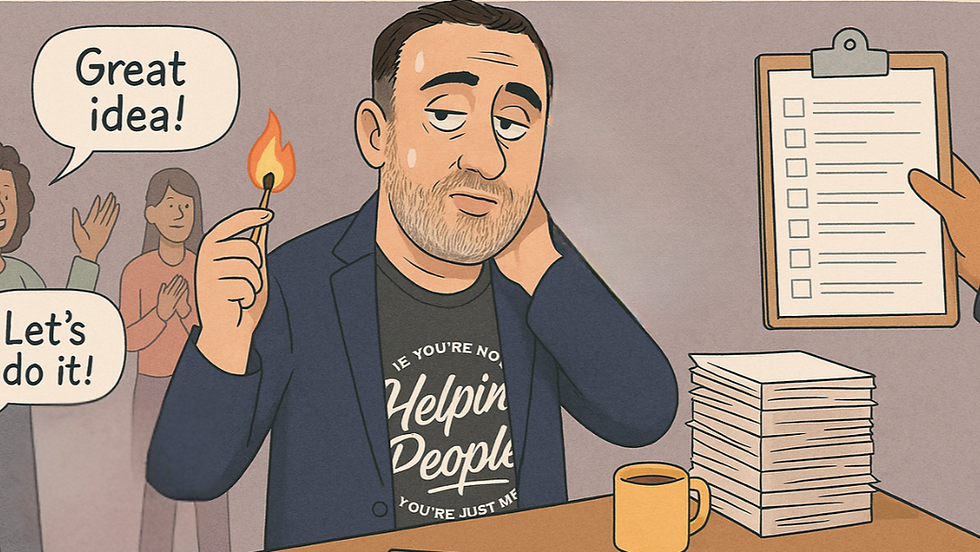
Founders often spend too much time worrying about small decisions and not enough on the big ones. Stephan Bajaio uses a simple rule: every decision is like a hat, a haircut, or a tattoo. You can change a hat in seconds. A haircut sticks with you for a month. A tattoo is permanent. The thing is, most decisions are like haircuts, but we act as if they are tattoos.
In this episode, Stephan talks with Craig Andrews about how to think differently as a founder with ADD, why the knowledge within your business is more valuable than anything an LLM can offer, and how search is changing as agents begin to deliver answers directly. If you run a business, make countless decisions each day, or feel overwhelmed by too much information, you'll find this episode helpful.
About the Show
This conversation originally aired on Leaders & Legacies, hosted by Craig Andrews.
Connect with Craig Andrews on LinkedIn.
Watch the Episode
Key Moments
00:00 Welcome and Introductions
00:52 Name Mixup and Nerdy Origin
02:05 ADD and Startup Mindset
05:50 Hat Haircut Tattoo Decisions
07:28 SEO Myths and AI Hype
11:43 Content Depth Beats Rankings
15:58 Web Presence and Vibe Coding
29:26 Future of Search and Proactive Agents
Full Transcript
[00:00:00] Today I want to welcome Stephan Bajaio. He is the CEO and co-founder of Vibe Logic. Stephan has spent his career helping companies understand how they, they're found from enterprise SEO and content strategy to the new world of AI answers, audience intelligence, and digital visibility. Uh, I'm really interested in that because I have a lot of questions.
[00:00:41] The world is changing. I know I'm hearing misinformation in that spot, in that space, so I love these type of conversations to re- bring that clarity. Stephan, welcome. Hey, thanks so much for having me Or Stephan. I said it again. Hang on. Let me back up and apologize to the listeners. He told me. I had it written down my- [00:01:00] No, no, no, no It's Stephan.
[00:01:00] It's Stephan. Yeah, Stephan, but you had... honestly, you had Bajillo, which is like the harder of the two. So, like, I, I didn't give you the, the precursor for people my age. People my age, I have to explain it's the cool version of Urkel, right? Yeah. Yeah. And having been a little nerdling, it's very appropriate for me to say that.
[00:01:18] I don't know if you remember, uh, fam- uh, what was it? Uh, oh, God, what was it? Oh, I don't remember. The Thursday night show with Urkel. It wasn't called Urkel. It was called Family Matters. Oh, yeah. And Family Matters, he jumped into a time machine, Urkel did, and he turned into the cool version of him named Stephan Urkel.
[00:01:37] So I like to say the cooler version of Steven is Stephan. So nice to meet you all. Thanks for having me, Craig. Well, we were talking about ADD in the green room, and heck, I can't even make it 10 minutes from getting your name pronounced right to screwing it up royally. It's... Dude, you got a lot going on.
[00:01:53] There's no question. I don't think any of us d- don't have information overload these days. So in all [00:02:00] fairness, I'm absolute crap with names. I don't blame you at all. Well, let's, let's talk about ADD a little bit because, you know, one of the things that I've realized, a lot of business owners, a lot of people that end up going into their own business go because they have some type of learning disability.
[00:02:20] We talked about Wayne A- 100 Got Junk. Yeah. Uh, he's dys- he's dyslexic. His dad was an attorney, wanted him to become an attorney, too, and he dropped out of school, dropped out of college in, like, a couple days, and went off and spent 1,600 bucks to buy a pickup and started hauling junk. Dad was proud. And, uh...
[00:02:41] Well, well, who got the last laugh there? So, you know, I definitely, uh, I, I get that. I get that feeling. I've, I've been, uh... it's, um... what's interesting, I've found with a lot of people that have ADD like myself and learning disabilities, of which I have both, you know, uh, slow reading, slow writing. I've never been the fastest at seemingly [00:03:00] anything.
[00:03:01] Um, what's interesting there is I also equate that to a lot of just, like, thinking differently. And so when you're set in a system, which makes sense, you're given a system, whether that's educational or corporate, right? You're probably the kid whose report card in second grade said, "Stephan has incredible insights and intelligence but is unable to follow direction," right?
[00:03:28] That's probably, like, the, the note that came back to my parents, you know, from my second grade teacher. And that's kind of true for, I think- Structured environments are difficult for people who have those issues, right? And so they don't thrive as well, um, because their creativity either or their, their desire, it's ne- it's not necessarily a question of passion, right?
[00:03:54] It's a question of if you're told you have to follow a particular path and do it a certain way, and [00:04:00] all you can see are the, let's say, the, the blank spots, the empty space as opportunity, becomes extremely frustrating yelling into the void saying, "Why aren't we doing this?" Right? And I remember doing that at Yahoo.
[00:04:12] I remember doing that, uh, at Time Inc. Uh, I remember doing that at a lot of corporations that I worked at where it was just like, this feels obvious. I don't understand why we can't do it. And the corporate structure really wasn't made for that. That's why I ended up in the startup world, really, because, um, you know, your impact wasn't, no matter how smart the idea or how valuable it might be, you couldn't test it.
[00:04:37] You had to get 500 people to approve something before you could do anything. Even if people, even if you're... I literally had clients at Yahoo asking to spend money with me on an idea that I knew I could fulfill, and I couldn't get management, let alone upper management, to pay any attention to it. And they were handing us dollars.
[00:04:55] So it was like, you know You know, it's funny, when people ask me [00:05:00] my, my ideal client size, um, when I tell them the upper limit, I say, "The upper limit is if it takes more than two people to decide to spend 1,000 bucks, they're too big for me." Ooh, I love that. That's really good. That's really good. Yeah. Yeah.
[00:05:16] It's just, it's cra- I mean, 'cause I used to work in corporate America, and I always did best in the smaller companies whe- when they were still sane and, and thoughtful. Sure. But when they got big, I just... It was a torture ta- chamber for me. And I remember sitting in conference rooms, and we're sitting there debating some stupid little purchase.
[00:05:38] And I'm looking around, I'm adding up everybody's effective hourly rate. Oh, yeah. And I'm like, "We just spent more money deciding to spend this money-" Right. Exactly ... than we did to spend it. Yep. Yep. I like to, uh... So there's something I learned recently that kind of, I think I've kind of applied in the past, at least tried to, which is there are three types of decisions when [00:06:00] you consider them.
[00:06:01] There's... It's either a hat, a haircut, or a tattoo. So a hat is, you can change a hat really easily, and it'll have no effect on your day. A haircut, you get a bad one, you're gonna have to live with it for maybe a month or so, depending how fast your hair grows and how bad it was. If you had long hair and you cut it, that's gonna be a different story.
[00:06:20] But essentially, it's a month, two months you're gonna deal with the ramifications of this decision. Tattoo, that's gonna be a long time. So, you know, the amount of, the amount of effort, time, and thought you put into some of these decisions, I've learned fairly quickly, especially now as a, as a bootstrapped entrepreneur, um, better to think about things in that context and move than, uh...
[00:06:45] Because most decisions aren't a tattoo, and you think of them as that, right? Because oh, my God, it could be the ramifications, da, da, da, da, da. Most of the time, at worst, things are a haircut. So could you live with a ba- bad haircut? Sure, you could. You know? It's not gonna [00:07:00] end your, your life, right? It might be uncomfortable.
[00:07:03] You'll have to deal with it for a while, but it's not the end of the world. It'll grow back. I love that framework. I'm gonna steal that. A hat, haircut- By all means. It's not even mine. I don't even remember where I saw it, but I thought it was genius, and I started using it. I... You know, and this is, this is an example of why I love podcasting.
[00:07:19] I get to have conversations like this. It's, it's a fantastic way for me to learn about things that are hard for me to learn otherwise. Um- Let's dive into the whole world of search. Sure. Um, 'cause that... I, I personally feel like there's a ton of misinformation out there. I, I hear stuff and I'm like, "I don't think that's right."
[00:07:44] And- Yeah, not that that's new, not that that's anything new, but it's like this whole AI thing has given this, you know, little cloud, this little nebulous cloud where you can feed in in- [00:08:00] misinformation and it comes out sounding normal. Oh, yeah. I mean, so, okay, in the search space, for context, right, I helped found Conductor.
[00:08:08] Uh, Conductor is, uh, the enterprise, essentially the enterprise platform of record for SEO. So, uh, I, I grew up essentially in that space, sitting across from Fortune 500, Internet retailer 1,000 CMOs. And in my own style, which is typical of me, uh, speaking truth to power, right? Telling them, "Hey, you're not, you're not set up for success right now.
[00:08:34] It doesn't matter if I have the answers to the algorithm, you're not gonna see the results you want," because nine times out of 10, they are their own worst competitor. Like, they can't get their act together. Like you said, two people to get $1,000 spend, impossible. So God forbid we're trying to actually get, you know, content live on the website or technical changes done, they're taking a ticket and waiting, and it's not happening, right?
[00:08:58] So they're not structured for [00:09:00] success. Um, when I look at the history of SEO, which I've been a s- significant part of, I'd say, right? And the industry kind of would, uh, would confirm that. Um, I'll tell you that there has been shiny object syndrome forever. Why? Because SEO is unsexy It's very unsexy. I'm asking you to look at your content, check whether or not the terms you're using are actually the terms of your consumer.
[00:09:28] I'm asking you to make technical changes that frankly raise more wristwatches than eyebrows in a, in a conference room, right? Um, and no executive wants to hear about. So, uh, you really live in a world where you control nothing but have a tremendous impact if you can get everyone to play nice with one another.
[00:09:47] So let's go back. People a while back were saying voice search would be the end of SEO. Oh, Alexa, oh my God. You know? Let's make recipes for Alexa. Well, I know a very large enterprise, [00:10:00] um, insurance company who made Alexa recipes. 70 some odd people used them. Their marketing department c- was about 150 people.
[00:10:09] Yeah. So that gives a sense of like, of where things were and what... So unfortunately, SEO by blog, which is like, "Oh, I read something, therefore we should do it," is a very typical way of people trying to do this. Now, okay, SEO, AEO, GEO, we can change the, the acronyms any which way you want. AIO. The reality is, O is what's at the heart of it, and you need to focus more on what you can control and what gets ingested by whatever is here and whatever's coming next.
[00:10:41] Now, I can tell you what's here is the dee dee dee dee dee dee dee dee dee dee version of AI. You are... If you're running after LLMs right now and you think a chatbot is the best version of what AI can give you, I hate to tell you this, it'll be like us saying, "Yeah, we'll be back in [00:11:00] the office in a..." If you're saying that around April of 2020, right?
[00:11:05] Yeah. Okay. We weren't back in the office for like three years, legitimately. Right. Right? So the reality is, when you go back and look at this in hindsight, this episode, you'll be s- probably saying like, "Wow." Yeah, optimizing for ChatGPT right now to show up there or to show up for Claude, a bit of a fool's errand, like the Gold Rush.
[00:11:27] The only people that made money in that were the people selling you the pans and the picks. So the reality is trying to show up there and spending a lot of effort there is not necessarily where I would spend my time right now, or money for that matter. Spend it on making your content more effective for the people you're trying to serve.
[00:11:50] Half the time... Screw that. 80% of the time, 85% of the time, if I come to your website, what you've treated as a bullet point is someone's entire purchase [00:12:00] reason, or their whole problem you're trying to solve, and you haven't even framed it as a problem. You're talking about it as your solution, right? Like, I always think about, um...
[00:12:09] I'll give you a prime example. Let's say you're in therapy. You're a therapist, right? And you have a page about grief. So grief, well, you might say we serve grief, right? A bullet point about loss of a parent, sudden loss, loss of a child, loss of a pet. Are you telling me that all four of these aren't different enough and warrant enough of a message that they probably require their own pages?
[00:12:36] So that if someone's looking for pet loss, they can actually find an entire page devoted to that, which is very different than loss of a child, right? Yeah. So but you're trying to treat that all as... And think about that with features for software. Think about that with functionality for particular things you're trying to sell online.
[00:12:53] It is very, very typical for someone to say, "Well, this is it," slap it up there, and then never look deeper to [00:13:00] understand that, wow, no, no, no, people care a lot more about this than I thought. Go into your own business, ask the questions, go look at the chat logs, go look at the sales calls. You have more data than you've ever had access to before, and you're letting something else synthesize it rather than going to the wisdom you already have, which is the true value, right?
[00:13:20] If, if- Yeah ... Craig, you and I have the same easy button. You've got the easy button called ChatGPT or Claude or Perplexity or Grok or Gemini, fill in the blank, right? And I have the same button. The only thing that's gonna make our results different is the dataset we work off of. So if you have insights, that's where you have to work them from, your own wisdom and your own...
[00:13:41] And that's how you build a better website, a better experience, a better everything, right? Rather than trying to chase whether or not an LLM happens to mention you at this time and place. And, you know, one of the things that you're saying there goes back ages ago, something Google's always said, uh, [00:14:00] not that I trust Google these days.
[00:14:01] I think they've gone away. Not at all, of course not. Um, but Google's always said, "Design for the user." Yes. "Design your website for the user." Yes. Which it's like the biggest duh statement ever, you know, that, you know, we do all these radical things, and we forget the user. I'm like, why are you d- why are you in business?
[00:14:21] Focus on that. Focus on your customers. And Google said that for years. And I remember, um, I remember I was at a conference in- I think it was '20, early '23 maybe, late '22. It was right after ChatGPT came out. Sure. And somebody asked, and Google, you know, you know Google always sends their reps to the conferences- Yep
[00:14:49] to give guidance. A, a lot of people don't realize that Google has long, for a long time has sent people to conferences to help people figure out how to be found on Google. And, [00:15:00] uh, but they sent a rep to this conference, and somebody asked, "Hey, do you have any issues if we write our blogs using ChatGPT?"
[00:15:07] And the g- dude from Google stood on stage and said, "Oh, no, we don't care." And I remember listening to that. I'm like, that's not true. That violates everything you've said for 20 years. Yep. And sure enough, like, you know, and so people are like, "Hey, we found our new blog writer. It's called ChatGPT." And two to three years later...
[00:15:28] Easy button. They, there's this concept of more rather than better. Yeah. And, like, the thing AI allows you to do is it's an amplifier, right? So, like, it, I just told you, oh, don't use it, don't go after AI rankings, quote-unquote, which don't really exist. They're not ranks, right? It doesn't go from most relevant to least relevant like a search engine.
[00:15:47] So it can literally boldface lie to you on the second thing it mentions, and you won't necessarily know that, right? So it's not a search engine. Treating it the same way is a fallacy. What I say is, [00:16:00] no, no, no, and this is what I coined called web presence intelligence, 'cause we needed another acronym. But essentially, what, what I like to do is I like to look at the search landscape of wherever you're looking, whether it's in Google or AI, in different models and stuff.
[00:16:15] What comes back? 'Cause what comes back is going to formulate opinions. Now, the question is, and the problem is, businesses are usually structured in their marketing by channel. Oh, this is social, and oh, this is, uh, this is display, and oh, this is partnership, and this is PR. Here's the problem. The web doesn't work that way.
[00:16:37] The web works cross-channel. The user could find frequently a video that shows up all the time. Okay, are we advertising there or not? Are we making a video that could compete with this video and ultimately be the one that gets found? Are we... I like to think of it as build, buy, or borrow your way into the conversations.
[00:16:55] Those conversations are gonna happen irrespective. The SEO version of the world [00:17:00] was, I have to be the answer. No, you don't have to be the answer. You have to have answers you've created internally with your content and be credible, and then you have to find places to intersect with that audience. Whether you buy your way in with display ads, whether you PR your way in because that's the author who wrote the article that keeps getting cited, and maybe you have them come write for you, which increases your authority.
[00:17:24] Or, you know, hey, there's a .org that keeps showing up all the time, and we've never partnered with these guys. They get visibility for all the stuff we'd love to do or show up for. How come we're not in bed with these guys? This is the kind of thing that like, again, when you're myopic and you're only looking at it through the silo of a channel and the KPIs are all measured that way, it's a fallacy.
[00:17:47] So my problem becomes, if you go to too big a company, enterprise, they don't know how to go cross-silo. The silos are the issue. If you go to too small a company in that regard, they don't have the [00:18:00] resources to actually execute. So you could literally give them all the answers and say, "Go place these bets," like on the roulette table, but they don't even have the ability to put the chips out, right, in the right spots.
[00:18:10] So it's finding that like specifically in web presence intelligence, I try to tell companies who approach me to do that too early on, I say, "Time out. Let's do a maturity assessment and understand where you're at." That's not to say you're not m- y- you may not be ready for a strategy like that, but you're always ready, and this is a big thing of how any company can use AI Look at your content that serves your consumer, your prospect, your customers the best right now, right?
[00:18:39] Look at that, get real feedback on that. And now look at whether or not the format it's in is the best version of what it could be. 'Cause AI allows you to change formats fairly easily, and you should be repurposing content using that. For example, I am shocked at how few companies have built, um, [00:19:00] interactive versions of their data online.
[00:19:03] I don't need it to rank. I just think it's really good. It could be something you send in your newsletter, something you, uh, something you promote at a conference you're at, um, something you even run ads against, right? All of a sudden, like I had a, I had a, a, an article I wrote that was like four pages long, and it was all about how one writer doesn't equal a certain number of blog posts.
[00:19:25] And I had to explain to executives like, hey, if they use a subject matter expert, if there are a certain amount of words, if it- if you have to go a certain round of reviews, all this takes time, right? So it's a variable. Now, if I thought that executive's going to read that, great. I created it as a piece of content, which frankly was, you know, written using AI and me and all this stuff I was prompting it.
[00:19:48] So I knew it wasn't gonna rank, but I was making it a white paper, so it didn't matter. It was gonna be gated and downloaded. And then I realized, no, no, no, no, no. Hold on a second. I went back to Claude and I challenged it. I said, [00:20:00] "I've given you all these things. Here's the time I think it takes to do all these and the factors.
[00:20:04] Let's turn this into a slider So now, on my site, there's something I call a vibe check, where people can actually slide back and forth. The executive can put that in and see an estimate of the amount of time it would take to produce that. Wow. That is just making it a lot easier for someone who I know was not gonna read an article of four pages long, right?
[00:20:24] Which might have been brilliant, in all fairness. It wasn't, but it might have been brilliant. They're not gonna be able to actually get the value out of that, so you convert it into something that's easier. Now, do I know how to code? No. It was completely vibe coded. Yeah. Completely. Right? And, and for those that don't know, what's vibe coding?
[00:20:41] So vibe coding is basically you don't know how to code, and therefore you go and you essentially use one of the LLMs to produce this stuff without a dev. So there's no developer involved. Essentially, you're telling it what you want it to do, and you keep going back and forth and wrestling with it [00:21:00] until it produces what you want.
[00:21:01] Yeah. It's a little more s- specific than that, but that's the general frame of what vibe coding is. Funny enough, think of it like this. My company's name is Vibe Logic. I'm definitely the vibe, not the logic side of that. The logic is what comes out of vibe coding, right? It's all the stuff I couldn't do because I am ADD and whatever, but I can sure express the feeling I want, the things I want it to do, the, the stuff, right?
[00:21:26] The vibe I need out of it. So that's kind of why that term vibe has picked up recently. I, um, I, I'm, I'm trying to get a Wikipedia entry for myself- Oh, good luck. Oh, good luck ... as, as being the first person to use the command more cowbell when programming my agent. I love it. I love it. I, I actually, I was trying to get it to adjust a logo size.
[00:21:50] I was like, no, I want it bigger, and it came back and it wasn't that big, and I finally just said, "More cowbell." And my agent responds, "More cowbell. Got it. Bigger logo. Clear the [00:22:00] crap." And boom, the next round was exactly what I was looking for. So by the way, I think that's also one of the most frustrating parts about AI right now that I, I just can't get over It's, it's like saying you and I have an internet connection, therefore, we both can create these Picasso websites, when the reality is w- we end up creating MySpace pages.
[00:22:25] Like, like ugly, you know, stuff that isn't great. And so in order to get to that, it's not as push-button as people make it out to be. You could wrestle for hours to get the AI to produce exactly what you want. The problem is when you then go tell someone it was built with AI, people go, "Oh, it must... You pressed a button and you must have gotten that out of it."
[00:22:44] Yeah. So that's the, that's the big, I think, our big struggle right now in society is AI produced must be easy. But that is not necessarily true, and, uh, one of the biggest problems is you could produce a lot of confident-sounding stuff, [00:23:00] right, that has the best poker face, that frankly, volume is not equal to expertise either, right?
[00:23:07] You could... I could hand you a 40-page report that seems so smart, but if you're an expert in that space and you read paragraph three, you're like, "Forgive my French, this is bullshit," right? Yeah. But executives aren't gonna know that necessarily, 'cause they're not necessarily experts in each space, so they go, "Oh, wow, Craig, what a...
[00:23:26] This is amazing. I've never seen this much documentation on X," right? And, and that's the problem, is the people consuming that stuff don't know better half the time, so- Well, here's, here's an example. Yeah. My, my brother-in-law, very senior developer. He works on kernel level software. Mm-hmm. Um, he's done a lot of work for the government.
[00:23:46] I think he's written viruses, um, you know, for the government. Okay. And, and he told me a couple months ago, he said, "I haven't written a line of code in two months." He's... All of his coding right now [00:24:00] is, you know, is vi- is, you know, using agents. Sure. And he, he was over, he was over here a couple weeks ago, and I asked him, I said, "Hey, if I'm using the same model that you're using, if I'm using the same AI that you're using, can I write the same quality code that you can?"
[00:24:17] And he said, "Nope. Nope." And I knew that would be the answer. Sure. And I think that's the thing that people need to understand in this whole world of AI. Yeah. The expertise is in a driver. If you put me in an F1 racer, I'm not gonna win the race. No. You're gonna crash it, honestly. Yeah. But AI is enough automation of driving that you won't crash it.
[00:24:41] You'll get around the track, but you will not win. That's the difference, right? And so it'll look like you're an F1 racer because you sat in the car and it moved fast, but that is not the same as winning the race. And so I think that's the biggest issue right now, honestly, is I think [00:25:00] people are way too worried about like, "What's the LLM saying about me?
[00:25:03] What's this? What's that?" No, no. No, no, no. What will always be at question is what it can learn about you. Now, you have three levels of control, right? Level one, what am I saying about myself? Easier said on a small website or one in which a small business has full control. Two, what's the rest of the web talking about when it references me?
[00:25:25] So that's everyone caring about, you know, am I mentioned in that Reddit thread? Am I spoken about on that, uh, that review site? Am I, right? All of that stuff, which frankly businesses should have been looking at to begin with, but they were so frankly, like, navel-gazing and egotistical in the way they approached it, that they thought they should always be the answer, that they didn't look at the rest of the supply, right, that was affecting people's, uh, opinions.
[00:25:51] And then a third part of that is, you know, um, how many of those things confirm the same thing about me, [00:26:00] right? So am I really, not just what's out there as a landscape, but are they all kind of referencing these things properly and in the best way so that all the signals are correct? But you're gonna... the rest of the web is not, in all fairness, like there's a, there's a, there's rented space, so to speak, where you're like, okay, your LinkedIn profiles and pages and social stuff, and things you actually have control over where you can go edit something versus, um, versus something that's completely separate, like a Wikipedia page or, you know, or, uh, you know, I'm trying to think of one that's not at all owned by anybody's capability to influence it.
[00:26:41] Um, I would say like a lot of the review sites and other things where, like, they're gonna do their review of you, and yeah, you could put a sponsorship on there, buy your way into the conversation. But really just being there already gives you a certain amount of cachet. So you really do have to realize that [00:27:00] the way to win moving forward is to actually realize the wisdom that's been sitting inside your business for a long time, and it's not always earth-shattering stuff.
[00:27:10] Like, you would be shocked how much... Your own red tape is literally value. I'll, I'll, I'll give you a very quick example. If you go look, if you're one of those companies that has a lot of legal requirements before you can publish anything, right? I guarantee you there's been 1,000 emails between your lawyer in-house, or even externally, and your writer, right?
[00:27:30] Or whoever's charged with publishing the content. Cool. So that's a lot of data you could feed an LLM right now to keep to yourself and look at, oh, before we publish the next piece of content, run it through the system that checks it against all these emails that we've gotten back from the lawyer, and tell me which one of them it would be breaking before I send it to the lawyer.
[00:27:52] Now, I'm saving billable hours right there. Two, when I send the email to Craig, my lawyer, and say, "Craig, I was gonna do this, this, and this, [00:28:00] but I checked it already for this, this, and this, 'cause you've told me in the past," do you think Craig's gonna let that fly now? Probably. He's probably going like, "Wow, Stephan's been paying attention to all the emails I send him about the legal stuff."
[00:28:12] Yeah. "I love this guy. Let, let's go." You know? And half those decisions, I hate to say it, are a little bit of, like, how they're feeling that day. So the reality is, like, if you build that, that was just made up of the, of... That, that was made up of red tape. That's the red tape that lives inside of your org that you were able to turn into value.
[00:28:30] So think about all the wisdom you have about what your clients care about, what makes them renew, what makes them buy more stuff. Um, what are they worried about? What are the things they complain about to your customer service? There's so much data there that you have access to that you can turn into really meaningful stuff that either helps your customer today- Or the future customer tomorrow that, like, it's an embarrassment of riches, and the, and you're worried about what LLMs are talking [00:29:00] about.
[00:29:00] It- Yeah ... this is, this is shiny object. The true value of what this is meant to do is make you look back in your business and say, "Am I doing a good job of recognizing what's important? Am I doing a g- good job of expressing that? And then how can I express that in multitude of ways now? Not more, but better versions of what I have so that other people can get value out of it?"
[00:29:23] When you do that, you win. So let's wrap up with this. The, um- Sure ... and it's a little bit of an open question for me, and it's the future of search, and let me give you a little bit of my- Sure ... little bit of my journey. When ChatGPT came out and then Copilot- Mm ... I started using that, and, but I'd still check blue links, and then I started noticing I'd use that more predominantly, look at blue links less.
[00:29:48] Sure. Uh, this year I brought up my own agent, my own OpenClaw agent, and, um, and what I'm finding is my use of things like [00:30:00] ChatGPT, Copilot, whatever your AI is, that's going down. I'm relying more and more on my agent where they can't stick ads in. They can't... There's, I'm not even looking at blue links anymore.
[00:30:12] Sure. Sure. Where are we gonna be two years from now? Okay. So that's a great question. Um- What's interesting is that I think agents, the way that we're using them today, is a little bit also like the BBS version of, you know, the internet. Okay? And we're excited because it's the first time we get access to these types of things, and they're being made, you know.
[00:30:39] But, but they're being made accessible. But let's, let's remember that there was a time in which people thought that Google's top result was the best result, and Google was God. Yeah. We haven't even reached that yet in the general populace of the internet. You're the tip of the spear right now in the stuff you're using, and we forget that when we're in our [00:31:00] bubbles of, like, the use of AI, right?
[00:31:02] The average person out there does not even understand what AI is meant to do. Now, where I think we're gonna go, all right, and I think Apple was probably the smartest ones in the whole game not getting directly into the mix when it comes to trying to build the agent world of LLM and stuff, because who cares?
[00:31:23] They don't care. They don't need that. What you need, again, getting back to the wisdom layer, is you need the data. Yeah. Which Apple is the operating level to do that. Why do you need that data? Because the more dots you have to now connect, the more proactive you can be. We are moving towards proactive web.
[00:31:45] Okay? Proactive web, you don't have to search for it, Craig, because it knows to search for it for you. You don't need to go in three apps anymore because it recognizes the connections of how you would use those apps together. Case in point, you and I are gonna go to [00:32:00] dinner We have an OpenTable reservation.
[00:32:03] Waze knows how long it'll take me to get there. Waze knows how long it'll take you to get there, right? Okay. It shows you're in traffic, so OpenTable, 'cause what am I doing at 60 miles an hour opening my OpenTable trying to change my reservation? If I'm asking Siri to do it, God knows that's not gonna work right now, right?
[00:32:20] But hopefully in the future. Why isn't this all working without me, right? So the concepts of these kind of agents working together with data and connecting the dots. Oh, guess what? We know you were going to a sushi restaurant. Hope you like sushi, Craig. And, uh, and we're gonna be late, so it actually didn't have another space for us later that night.
[00:32:42] It actually moved us to another place with similar reviews about three blocks away, and it booked a, a garage for you and I, and we got a discount because both of us are showing up at the same time or within a certain window. So the system had a reason to give us both a [00:33:00] discount, and we didn't have to do anything.
[00:33:02] Yeah. Didn't have to do anything. That is the world, in my mind, of where this all turns into. The idea of searching, the searches will be brought to you, right? It'll be intuitive. In, in three years, you won't have to enter as much of the query, as it'll understand and tell you about the things you wanna know about.
[00:33:23] Much like your algorithm feed is in your social, you'll be seeing search almost actively working for you, bringing you opportunities and things you'd be interested in based on your history. I don't know if everyone's gonna wanna accept that, 'cause it is scary privacy kind of thing, but those that are more on the tip of the spear are not gonna have to actively do the searches.
[00:33:44] The funny part about that is it doesn't change the idea that it still has to ingest something, right? It still has to... The data still has to be there to make those decisions off of. So while you may not actively be entering things as much, you will still be [00:34:00] seeing data, getting data back, and all that sort of stuff.
[00:34:02] I think it'll just be synthesized in a better way. Well, here's an example. Um, I had something come up tomorrow morning where I had a couple meetings to reschedule And one of the meetings was, was somebody I've never met. And so I went into my CRM, uh, to shoot out some proprietary times that aren't on my regular calendar, and there's a note inside my CRM that had been put in there by my agent.
[00:34:28] Uh, so I work with wealth managers. It had scanned the SEC's website, pulled his ADV, and was telling me exactly how many assets under management he has, which lets me estimate his revenue. And that's just a note- That's- ... sitting there waiting for me. I never had to... Uh, uh, it was just hanging out. Well, I mean, that, the ideal would've been for it to flag you in advance.
[00:34:49] You don't have to go into the inbox. And it says, "Hey, there's a conflict. Here are the three people that are up for that same spot. And by the way, here's the one I'd consider based on." [00:35:00] Or it would ask, "Hey, are you looking, is this new business that you're looking for? Is this client related, or which one would you prioritize?"
[00:35:09] You tell it, and then it gives you the suggestion as to which one to go to, and you never have to read that information, right? Yeah. That's the reality is, like, now, we have to be careful because- If it gave you the wrong information, how are you gonna QA that, right? We don't know. And it could be helping you make decisions that are wrong.
[00:35:27] We don't know, right? So a lot of that is gonna come down to confidence scores, the ability for something to tell you, "Hey, the response I'm giving you is better than the flip of a coin. It's an 85%- Yeah. Mm-hmm ... or this has a 20% certainty of being accurate." We don't have that right now in the data we get back.
[00:35:45] We just have blind trust. And what we're gonna see is, just like the internet, remember people weren't willing to put their credit cards in, right? Because it was like, "Oh my God, I, I don't wanna put my... In 2000, I didn't wanna put my credit card online. I can't do that. I can't bank online. How would I [00:36:00] ever do that?
[00:36:00] That's crazy." Well, I think we're gonna see an adoption, a drop, because people's trust are, will be broken. And then I think you, as the agents that I've talked about that connect these dots, that make life easier, 'cause we all need that, we're overwhelmed by decision fatigue. When that thing starts reducing decision fatigue and taking the decisions off the table for you, scary as that is to say, people will start, uh, the general populace will start adopting AI a lot more.
[00:36:29] Excellent. And see its potential. So. Well, Stephan, this has, uh, been an amazing conversation. Thank you. I wish we could do another hour. Uh, how, how can folks reach you? Because this gets, as you say, I'm on the tip of the spear. Yeah. Most business owners aren't. No. And, and so this gets confusing. People need- Yeah
[00:36:50] people need clarifi- need voices to help them sort through this. How can folks reach you? Sure. And guidance, absolutely. So, uh, obviously vibelogic.com. [00:37:00] Uh, that's my website, my organization. Feel free to reach out there. Um, one of the other definitive, my, you know, drug of choice when it comes to social is definitely LinkedIn.
[00:37:10] I'm constantly putting, uh, content out. Um, again, this isn't just a T-shirt. If you're not helping people, you're just selling stuff. I'm not in the business of just selling stuff. Don't get me wrong, I like to make money like everyone else. Uh, but I really do like helping businesses achieve their potentials.
[00:37:26] So if people are interested in understanding more about how they can show up, where they should show up, why they should show up, and what they should be saying when they do, um, feel free to reach out to me. No selling. Don't sell me. I don't need to buy anything right now. But, uh, but please do reach out on LinkedIn.
[00:37:43] Um, that's a great place to get me, and mention that you, you saw me here so I have some context, and, and all that good stuff. But I, I really appreciate the time, Craig. It's been such a pleasure. Well, thanks for coming on Layers and Legacies. Thanks for having me.
Want to see where buyers form opinions about you before they ever reach your site? Explore our free tools and resources, or book a discovery call to talk through your own web presence.


Comments