The Hidden Cost of Being a High-Energy Leader

(And What to Do When Your Best Trait Starts Backfiring)
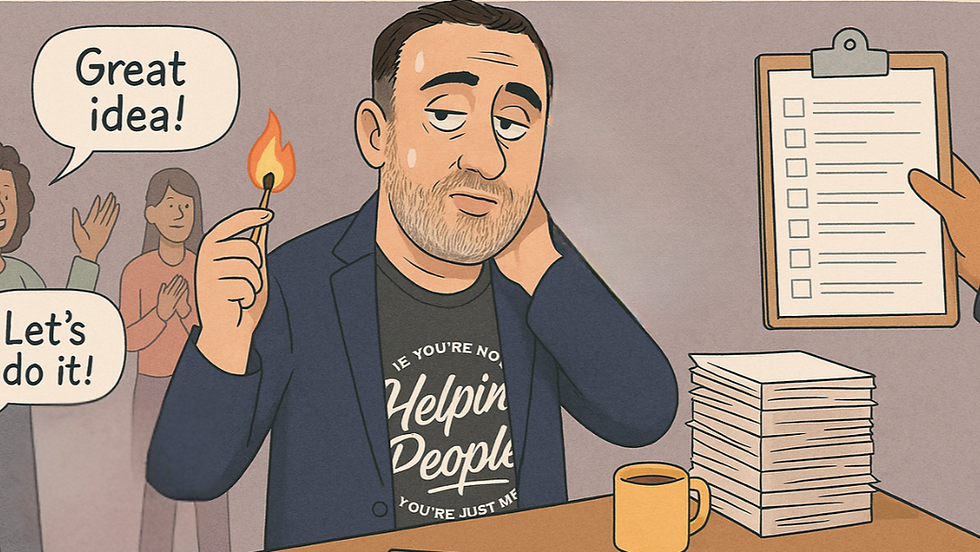
Ever been told you’re the spark?
The person who lights up the meeting.
The one with the big idea.
The one who “gets people fired up.”
Great. Until the energy that inspires others starts quietly draining you - or worse, your team.
This isn’t a humblebrag post. It’s a reckoning.
Because being the motivator, the connector, the idea factory - it’s a lot. And if you’re not intentional, it breaks things.
Slowly. Quietly. Then all at once.
The Good Stuff First (Because That’s Where We Like to Start)
I’ve taken every personality, strength, leadership, and energy-style test you can name.
Myers-Briggs. MAPP. Insights Discovery.
Spoiler: They all say the same thing.
Motivating Inspirer.
High-energy visionary.
Creative connector.
I can rally a room. I thrive on people. I get obsessive about making ideas land. And I tend to juggle 10 conversations at once - across Slack, email, text, deck, and doc.
It’s not performative. It’s not for show. It’s just how I’m wired. And when it works, it works really well.
Big ideas get buy-in.
Teams get energized.
Momentum feels natural.
But it doesn’t always work.
Where It Starts to Crack
Here’s what no one tells you when your strength is your energy:
You overcommit without realizing it.
You leave a trail of 80%-done projects.
You interrupt meetings with “one quick idea” that derails the whole plan.
You take silence personally when your vision doesn’t immediately resonate.
You get bored. Fast. And then move on - leaving others cleaning up.
I once built out an entire marketing brief for a new campaign on a Monday… and by Friday, I had pitched three new directions to the team. I thought I was being helpful. They thought I was nuking their roadmap.
They weren’t wrong.
Let’s Call It What It Is: Blind Spots
When people say, “You’re so creative,” they’re not necessarily complimenting you.
They’re probably bracing for another pivot.
So let’s own this. These are real pitfalls of being the high-energy type:
Momentum ≠ Progress Moving fast feels productive, but speed isn’t the same as traction.
Inspiration Without Execution = Frustration Your team can’t chase every idea. They need structure—and so do you.
Charisma Can Cloud Feedback People hesitate to push back when you’re “on fire.” That’s when you most need someone to say, “That doesn’t make sense.”
What I Do Differently Now (Most Days)
I didn’t fix this overnight. I still fall into the same traps. But here are five specific things that help me rein it in, stay focused, and lead better:
1. Pair Every Visionary With a Finisher
Example:
At Conductor, I had a teammate who was my complete opposite. While I was throwing sparks, she was lining up buckets. Every time I had an idea, her first question was, “What does success look like?” That forced me to think past the hype and into the how.
Tactic:
Every project needs a dual-owner model:
One who ignites
One who grounds and completes
2. Set a Weekly “Reality Check” Block
Example:
I block 30 minutes every Friday. No new ideas allowed. Just me, my task list, and a brutally honest check-in:
What’s open?
What’s stuck?
What got ignored because I moved on too fast?
Tactic:
Make it sacred. No meetings, no Slack. Just truth. Don’t ship chaos into next week.
3. Use an Idea Parking Lot (Seriously)
Example:
In my early leadership days, I had no filter. Every idea had to be acted on immediately or it would evaporate.
Now? I park ideas in a shared doc. I revisit them every two weeks with the team. If it still excites me and fits into a plan - we move. If not, it stays parked.
Tactic:
Create a “Future Fuel” doc. Date each idea. Review with someone else before you act. Most ideas age well or die peacefully.
4. Run a Blind Spot Session Quarterly
Example:
Once per quarter, I ask my team to give me raw feedback on how I show up. Not a performance review, just a pattern review.
One person told me, “You ask for input, but it feels like the decision’s already made.”
That stung.
But they were right.
Tactic:
Ask your team:
What am I not seeing?
Where am I creating confusion?
What should I stop doing?
Reward honesty. Don’t defend yourself.
5. Define “Done” at the Start
Example:
In one client project, I kicked things off with, “We want to create something great that gets noticed.”
Two weeks in, no one knew what “great” meant. I hadn’t defined the outcome. Once we agreed on success metrics, clarity snapped into place.
Tactic:
Before starting anything, write down:
What does success look like?
Who’s owning what?
What’s not included?
Then gut check: “Can we finish this with the team we have?”
Be the Spark - But Build the Structure
You don’t need to dull your shine.
You don’t need to go slower.
But you do need to lead with both energy and intention.
Energy without structure burns people out.
Ideas without follow-through erode trust.
Momentum without direction just spins wheels.
You’re not just there to start things.
You’re there to make sure they matter.
Try one of the five strategies this week. Which one would help you most right now? Or better yet, forward this to someone you know who’s doing 100mph without a map.


Comments